Types of visual language
Complementary harmony
Watch this presentation to know what a complementary color is:
0. Complementary colors
We are going to finish making the last table with a range of complementary colors. Choose a primary color and its complementary color, and check out this tutorial:
1. Complementary color.
The artistic application is to make the tail of a silhouette and color it with the same scale you did on the table. Check out this tutorial:
2. Complementary colors artistic application
Interpretation of an image
Make this face in a figurative way, that is, without making an exact copy of reality, but contributing your own expressiveness. Use colored pencils and apply different strokes.
Art expression elements
Point from Nombre Apellidos
Line from Nombre Apellidos
Texture from Nombre Apellidos
Color from Nombre Apellidos
Here you can see some works of my students, using points, lines and spots inan original way.
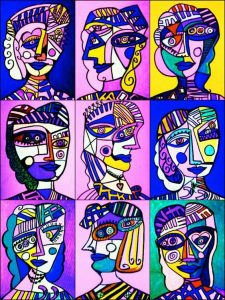
How to make a cubist portrait?
Scenography
This is a nice work for developing our creativity. We have to make up a miniworld into a box, through cut outs, silhouettes, and a careful composition. The results are really nice.
Warm and cool colors
We are going to complete the 2nd and the 3rd table that we made two weeks ago, the 1st one has the gray scale.
In the 2nd table we are going to make a range of warm colors.
In the 3rd table a range of cool colors.
You can only use your colored pencils and the 3 primary colors, yellow, magenta and cyan blue.
You have to see the tutorials in this order:
1. Warm range
2. Cold range
To do this exercise I offer you two options:
1. A drawing using the silhouette of your hands.
2. A drawing using a symmetrical figure cut out of cardboard as a silhouette. You can use all the colored pencils you have but divide them between warm and cold colors. If you don’t have many colors you can mix them to get more shades.
In this work we’ll work with recycled materials as diary paper. This technic is called papier maché, and you have to mix paper with white glue. We’re going to make birds, and we’ll paint them using temperas. Each student will choose if he or she wants to paint the bird in warm or cool colors.
In this exercise we’ll work with temperas, applying our knowledge about cool and warm colors. In this case we’re going to make a selfportrait.
These are the final results.
Aquarium
The class is divided into three groups that will work in differents aspects: point, line, plane with textures. They can work with dry and wet techniques, markers, colores pencils and tempera.
It will work in pairs on a large card:
- There will be three boxes with points, lines and planes with textures.
- Each pair of students will select the papers they like for their own work, which will consist of representing a MARINE ANIMAL. These papers should be adjusted to the needs of they want to represent.
- When you have drawn the outline of the FISH, you’ll have to fill it out by cutting the pieces of paper that interest them and sticking them in the most appropiate areas.
- Afterwards, the different results will be shown and an aquiarium will be made as a mural.
Aquarium from Nombre Apellidos
- These are the fish that students made:
Christmas tree
In this work we’ll work on flat geometry, specifically the dodecagon, and the chromatic gradations with temperas.
Here you can apreciate the varieties of Christmas trees that the students made. The result was very nice and to see them all together a very interesting experience.
Polygons
Polygons from Nombre Apellidos
How to draw an octagone inscribed in a circle:
How to draw an heptagone inscribed in a circle:
How to draw a pentagone inscribed in a circle:
How to draw an hexagone:
Here you can find the characteristics of a polygon:
Polygons For Kids Rap Song | Geometry Video
https://youtu.be/zI3rUMrRLF8
Star polygons
First thing we have to do is to find out the center of the sheet:
Once you have have found the center of the sheet….watch this video. In this video you can see how to make and decorate a star polygon, but it is only a suggestion, now you can choose the number of sides of your star polygon and decorate it however you want.
Starting from a star-shaped polygon of more than 12 points, the students have made a mandala like the ones you can appreciate here in this video: